Musty Smell in Basement: What It Means and How to Trace It
Last reviewed 2026-10-30
A musty smell in a basement points to moisture, and likely mold you haven’t found yet. The EPA says “damp or musty odors suggest that water is or was present and mold growth is likely,” and that a moldy odor “should be investigated.” Start by measuring the humidity and looking for wet spots, condensation and stored items that have gotten damp. If humidity is high, bringing it down is the first step; if the smell stays and you can’t see a source, mold may be hidden behind a finished wall, under carpet or in a crawl space — that’s when a professional inspection makes sense. Covering the smell doesn’t solve it: the EPA counts mold work as finished only when the moisture is fixed and “visible mold and moldy odors” are gone.
What the smell is
Growing mold releases compounds into the air that the EPA calls microbial volatile organic compounds (mVOCs). Because they often have strong or unpleasant odors, the EPA says they “can be the source of the ‘moldy odor’ or musty smell frequently associated with mold growth.” Minnesota’s health department describes mold odors as “musty or earthly,” and its advice is blunt: “If you see or smell mold, you should assume that a problem exists.”
So the smell is information. It tells you there is, or was, enough moisture for something to grow — even if nothing is visible yet.
Common sources: humid air, condensation, leaks, hidden mold
Humid air. The EPA’s moisture guidance calls basements and crawl spaces “holes in the ground” with more contact with soil than slab-on-grade foundations, and notes that damp basements or crawl spaces “may add as much water vapor to the air in a day as all the other internal sources combined.” The EPA recommends keeping indoor humidity below 60 percent, ideally 30–50 percent.
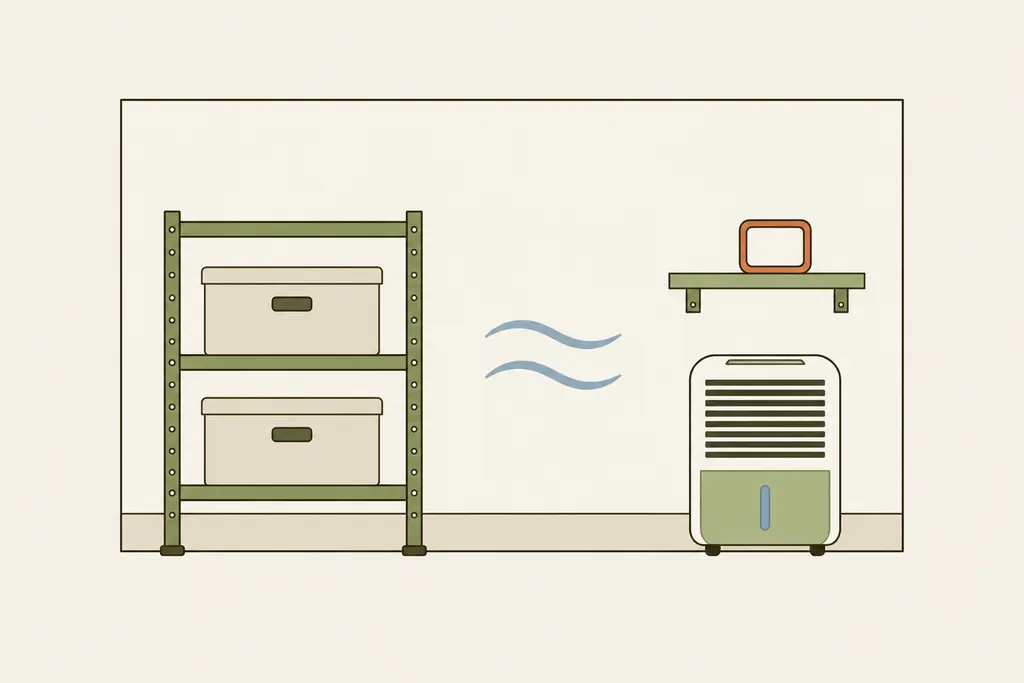
Condensation. In warm weather, foundation walls are cooler than the outdoor air, so water can condense on them, according to the EPA’s moisture guidance. The EPA says condensation “can be a sign of high humidity.” If the smell is worse in warm, humid weather, check for condensation first.
Leaks and seepage. Leaking or condensing water pipes are on the EPA’s list of common moisture sources, and the EPA’s moisture guidance notes that water from rain and plumbing leaks is drawn by gravity to foundations, which are exposed to rain-soaked soil and possibly high water tables. The full list of basement moisture sources is in mold in basement.
Hidden mold. The EPA says you may suspect hidden mold “if a building smells moldy, but you cannot see the source.” Hiding places on the EPA’s lists include the back side of drywall and paneling, the underside of carpets and pads, and damp areas in crawl spaces. Moisture from a crawl space can also move into the rest of the house through cracks in walls, floors and ceilings (EPA). White deposits in a crawl space or on basement walls are covered in white mold or efflorescence.
How to trace it
These are checks, not repairs — nothing here involves opening walls or disturbing mold.
- Measure the humidity. A humidity meter (hygrometer) costs about $10–$50 at hardware stores, according to the EPA. Check it on several days and note when the smell is strongest — after rain, in summer, or all year.
- Look for condensation. The EPA’s foundation checklist includes condensation on pipes, tanks, pumps, ducts, walls and floors.
- Look for signs of seepage. The same checklist lists water stains, damp materials, white mineral deposits (efflorescence), peeling paint and mold growth on foundation walls and finishes, plus swollen or warped wood.
- Check stored items and furnishings. Minnesota’s health department suggests searching behind and underneath furnishings and stored items. Cardboard boxes against a foundation wall are an easy place to start.
- Is moisture coming through the wall? This Old House passes on a tip from its general contractor Tom Silva: place plastic panels against a foundation wall and check for condensation after a few weeks. If condensation collects between the plastic and the foundation, the article says, the foundation is not properly sealed.
Stop at looking. The EPA cautions that investigating hidden mold requires care because disturbing it may spread mold through the building.
When a mold inspection makes sense
If humidity is under control and the smell is still there, or you’ve found signs of water but not the source, it’s time for a professional. For hidden mold, the EPA suggests considering “an experienced professional,” and its mold course notes that investigators may use moisture meters and borescopes — an optical probe inserted through a small hole — to look inside walls without tearing them open. When you hire, the EPA says to make sure the inspector has experience finding mold and water problems and to check references.
Testing alone is a different question. The EPA says “in most cases, if visible mold growth is present, sampling is unnecessary,” and notes that an air sample shows conditions only for the moment it was taken. Minnesota’s health department says that in most situations it does not recommend mold testing: “It is usually better to use the money you would spend on testing to solve the moisture issues and clean up mold.” Prices: mold inspection cost and mold testing cost.
Call a mold remediation professional when:
- the mold you find covers more than about 10 square feet — below that, the EPA says that in most cases a homeowner can handle it;
- it followed a flood, a sewage backup or other contaminated water — the EPA says to call in a professional with experience cleaning buildings damaged by contaminated water;
- you suspect mold in the furnace, air conditioner or ducts — the EPA says not to run the HVAC system if you know or suspect it is contaminated, because it could spread mold through the building;
- the mold is inside walls or hidden — a musty smell with no visible growth is exactly this case;
- someone in the home has health concerns — the EPA says to consult a health professional before cleanup starts.
The Mold Check includes an “I can’t tell (hidden, smell only)” option for this situation.
Getting rid of the smell for good
The smell goes when its source does. That means two things, in this order: stop the moisture, then remove whatever is growing. The EPA’s test for a finished job is that the water or moisture problem is completely fixed and “visible mold and moldy odors should not be present.”
To keep a basement drier, the EPA recommends running an air conditioner or dehumidifier when needed, insulating cold water pipes, and keeping the ground sloped away from the foundation.
Some air cleaners are designed to produce ozone. Minnesota’s health department says studies have shown ozone is not effective at killing airborne or surface mold, and that it does not recommend ozone for mold or any other indoor air problem.
How serious is your mold? Take the Mold Check
Next step: get an on-site assessment from a licensed mold remediation professional.
Ask for a written scope that covers the moisture source, containment, removal, and how they will confirm the job is done.
Sources
- U.S. EPA — Mold Course, Chapter 1: Introduction to Molds (last updated Feb 18, 2026)
- U.S. EPA — Mold Course, Chapter 2: Why and Where Mold Grows (last updated Dec 1, 2025)
- U.S. EPA — Mold Course, Chapter 3: Finding Mold and Moisture (last updated Dec 1, 2025)
- U.S. EPA — A Brief Guide to Mold, Moisture and Your Home (last updated Feb 18, 2026)
- U.S. EPA — Moisture Control Guidance for Building Design, Construction and Maintenance (EPA 402-F-13053, Dec 2013; Foundation Maintenance checklist, p. 92)
- Minnesota Department of Health — Mold and Moisture (last updated Feb 19, 2026)
- This Old House — Why There's Mold in Your Basement and How To Prevent It (updated Jun 6, 2026)
Illustrations on this page are AI-generated to help you picture the situation. They are not photos of real homes, jobs or people.
Health and safety. Mold can affect health, especially for people with allergies, asthma, or weakened immune systems. This site does not give medical advice — for health concerns talk to a doctor. For mold removal, contact a licensed mold remediation professional (licensing rules vary by state).